
Beaches on La Palma: Black Sand, Natural Pools and the Wildest Coast of the Canaries
Black. Warm. Untouched. You step onto the volcanic sand, and the water ahead is as clear as a diver’s mask. La Palma’s beaches are not a mass product — they are the result of millions of years of volcanism, wind and the Atlantic Ocean. Those who swim here swim at a place shaped by nature with no regard for tourist wishes.
36 Swimming Spots from Los Cancajos to Fuencaliente
With 36 beaches and natural pools spread along the entire coast, La Palma offers the right spot for every type of beach: Playa de Los Cancajos right by the airport with calm water for families and snorkellers. The wide black sand beach of Puerto Naos with over 300 sunny days a year on the west coast. The enchanting Playa de Nogales in the north, reachable only via a hundred steps. The natural pools Charco Azul and La Fajana, where Atlantic water flows in directly. And at the very south, at the foot of two volcanoes, the beach Playa Echentive with the emerald-green natural pools of El Aljibe.
Puerto Espíndola – The Harbour of San Andrés
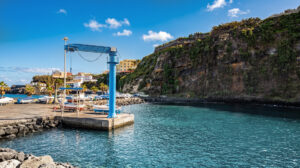
In San Andrés, one of La Palma’s most beautiful historic old towns, there is more to discover than the main street suggests. Just a short stroll from the town centre lies Puerto Espíndola — a picturesque fishing harbour where local boats still bob gently in the water, rum is made from locally grown sugar cane, and the crystal-clear waters of the Atlantic invite you for a swim.
Playa de Bujarén – Garafía’s Secluded North Beach
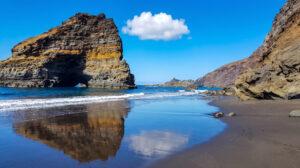
Garafía’s north coast is no place for beach outings with sun loungers and kiosks. It is a place for those seeking a coastline that makes no effort to attract visitors. This is where Playa de Bujarén lies: a small, unspoilt beach beneath sheer cliffs, reachable only via steep paths, almost always deserted.
Playa del Callejoncito – Garafía’s Hidden Beach
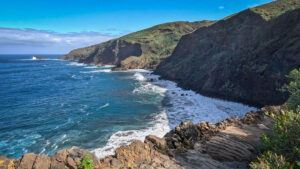
Callejoncito means ‘little alley’ — and the path leading to this beach earns the name. Narrow, steep, wedged between rock: those who visit Playa del Callejoncito didn’t just stumble across it; they sought it out. This beach on Garafía’s north coast is invisible to the vast majority of La Palma visitors. And that is part of its essence.
Playa de La Salemera – Unspoiled on the Southeast Coast
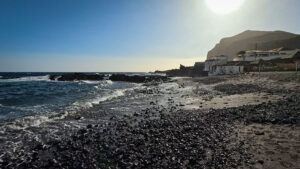
On the southeast coast of La Palma, a few kilometers from Villa de Mazo, lies a beach that doesn’t seek visitors and doesn’t need them: Playa de La Salemera. An unspoiled black sand beach — for those seeking a stretch of coastline that looks exactly as it did fifty years ago.
Puerto de Talavera – Cave Dwellings, History and Clear Water
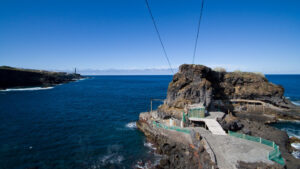
The small, rugged headland on Barlovento’s northeast coast looks almost inaccessible. But appearances deceive. Puerto de Talavera was one of the most important landing points on the north coast until well into the 20th century — fruits were shipped from here before roads connected the coastal communities to the rest of the island. What remains from that era still stands.
El Remo – Where the Fish Is Still Fresh
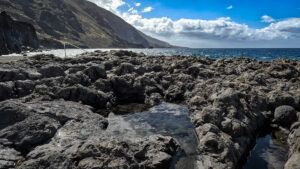
There are places on La Palma you don’t visit because they’re beautiful. You visit them because they’re real. El Remo is one of those places: a small coastal settlement south of Puerto Naos, with a black sand beach, a few fishermen’s huts, and restaurants where what lands on your plate was in the net that morning.
Porís de Candelaria – The Pirate Cove
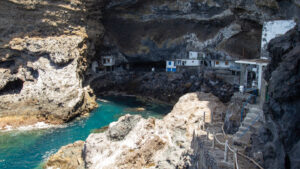
Some places explain themselves the moment you see them. Porís de Candelaria is one. Beneath a massive rock overhang, about twenty small white houses press against the sea — some carved into the cliff, some squeezed between, as if someone built a village that didn’t want to be found. In this seclusion lies the name: Pirate Cove.
Playa de La Bombilla – Quiet Neighbour of Puerto Naos
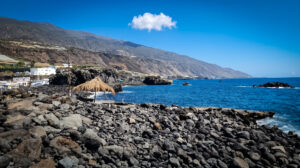
La Bombilla is undergoing a controlled, phased reopening. After the 2021 Tajogaite eruption, the first residents are slowly returning — the place is coming back to life, but under strict conditions and with permanent CO₂ monitoring.
Playa de El Pozo – Quiet Beach near Villa de Mazo
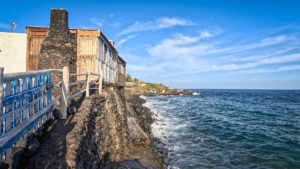
La Palma’s south-east coast between the airport and Fuencaliente is not classic beach territory. The coastline is rocky, the surf sometimes strong, the infrastructure minimal. And that is precisely why Playa de El Pozo near Villa de Mazo is a beach for those who are not looking for what everyone else is looking for.
Playa de Bajamar – City Beach of Santa Cruz de La Palma
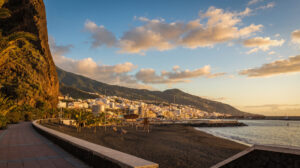
Those who explore the old town of Santa Cruz de La Palma and still want to swim at the end of the day don’t need to go far. Alongside the better-known Playa Santa Cruz de La Palma, the island capital has a second city beach: Playa de Bajamar, tucked into the urban coastal strip between the harbour and the promenade.
Puerto de Puntagorda – Rock Pools and Sea Caves
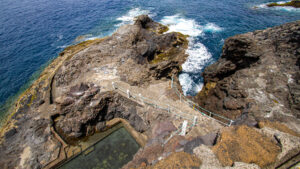
La Palma’s north-west is a different chapter. Puntagorda, known for its almond groves and the silence of its high plateau, also has a coastline — and it is so remote that many visitors never discover it. Puerto de Puntagorda is not a harbour in the classic sense; it is a small rock landing at the foot of the cliff coast, featuring natural seawater pools formed by lava rock, and caves that the water has carved into the stone. Beneath a massive overhanging cliff wall, locals built their huts directly into the rock — not a place you stumble upon, but one that lets you find it.
Porís de Santo Domingo – Wild North of Garafía
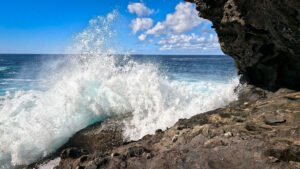
Garafía is the wildest municipality of La Palma – this is not a marketing phrase, but a geographical fact. In the north of the island, where steep cliffs drop vertically into the sea and barely a road reaches the water, lies Porís de Santo Domingo: an old harbour cove from which generations of farmers carried their goods to sea before roads connected the villages.
Playa del Jurado – Black Wild Beach near Tijarafe
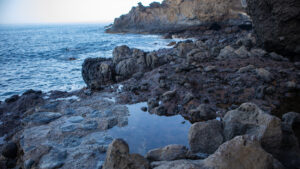
At the end of the Barranco del Jurado, cut deep into the west coast of La Palma, lies a bay you reach on foot – or not at all. Playa del Jurado is not a swimming beach for a relaxed day on a sunbed. It is a reward: for the descent through the gorge, for the final steep path, for the decision to go further than most people do.
Playa de la Veta – Black Sand Beach Through the Rock Tunnel
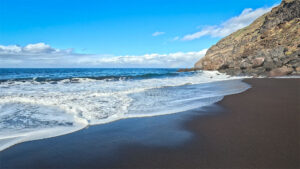
It starts at a car park at the end of a winding road, leading to a dark tunnel cut through the rock. At the other end the coast opens up, and below, at the base of a 200-metre-high cliff, lies Playa de la Veta: a black sand beach that forms only in spring and summer, and is reclaimed by the sea each winter. A route over cliffs, stone steps and steep faces.
Playa de Las Cabras – Secluded Beach near Fuencaliente
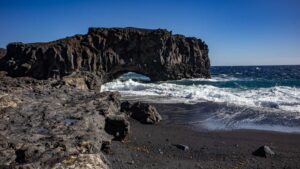
Right at the bottom, at the very south, where the natural monument of the Volcanes de Teneguía meets the sea, lies a bay you do not find by accident: Playa de Las Cabras. Forty metres long, twenty wide, framed by jagged lava rocks – small enough to give the feeling of absolute solitude, large enough to swim and snorkel.
El Aljibe – Turquoise Rock Pools and Thermal Spring
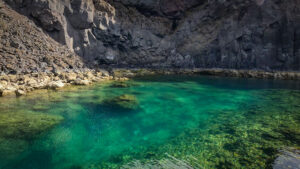
There are places on La Palma where you instinctively fall quiet. El Aljibe is one of them. Turquoise-green water resting in natural rock pools, surrounded by black volcanic stone – and beneath it, invisible, the warmth of the earth itself. Nestled amid the pitch-black lava fields created by the Teneguía volcano in 1971, the natural pools of El Aljibe are sheltered and extraordinary. While outside the Atlantic surf crashes wildly against the cliffs, the tides regularly fill these natural basins with fresh, crystal-clear seawater. In the shallow, wind-protected pools, the Canarian sun warms the water pleasantly throughout the day.
La Fajana – Natural Seawater Pools near Barlovento
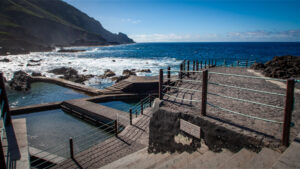
In the north-east of La Palma, a few kilometres from Barlovento, lies one of the island’s most hidden bathing delights: the Piscinas de La Fajana. Three natural swimming pools carved in lava rock, competing daily with the Atlantic surf – and on calm days one of the finest and least-known natural lidos in the Canary Islands.
Charco Azul – Natural Seawater Pools near San Andrés
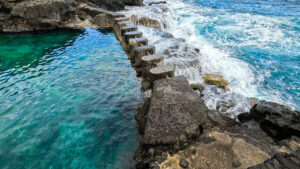
Charco Azul means blue lagoon – or, more modestly translated, blue puddle. What lies behind the name is one of La Palma’s most beautiful natural lidos: three seawater pools in lava rock, sheltered from the Atlantic surf, located between San Andrés and Puerto Espíndola. Calm, well-maintained and popular – especially with locals.
Playa del Faro – Pebble Beach beneath the Lighthouses
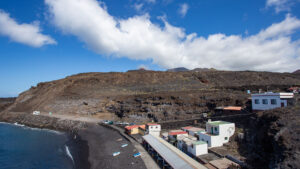
At the very southern tip of La Palma, below the two lighthouses of Fuencaliente, lies Playa del Faro. Small, pebbly, and unpretentious — yet easily one of the most memorable beaches on the island. Not for its size or facilities, but for its setting: lighthouse above, Atlantic ahead, lava cliffs left and right.
Playa Echentive – Black Beach on the Teneguía Lava Field
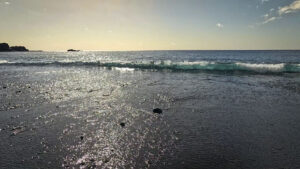
At the southern tip of La Palma, where the Fuencaliente lighthouses mark the horizon and the island’s youngest lava lies bare and black, lies Playa Echentive. Not a beach idyll in the classic sense – but a place that draws its beauty from a different source: the silence, the vastness, and the awareness of standing on new land.
Playa de la Zamora – Two Bays in the South
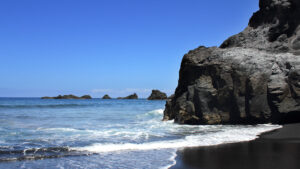
On the south coast of La Palma, where the island tapers to a point into the sea and volcanic cones and lighthouses shape the landscape, lies one of the quietest beaches on the island: Playa de la Zamora. Two black sand bays, separated by a rock, almost always deserted – yet close enough to the only tourist zone on the island not to feel truly remote.
Playa de Nogales – Black Natural Beach in the Northeast
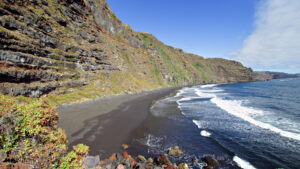
The wild green cliff face rises steeply behind Playa de Nogales, providing ideal wind protection. At the same time it means that from midday no sun reaches here any more. Those who want to make the most of the sunshine should set off in the early morning hours – and then enjoy one of La Palma’s most unspoilt beaches entirely for themselves.
Playa de Los Cancajos – The Beach Resort of the East Coast
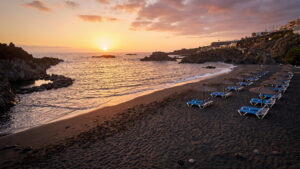
Those arriving at La Palma Airport and heading straight for the water will sooner or later end up at Los Cancajos. The beach is just a few minutes south of Santa Cruz de La Palma – easily accessible, awarded the EU Blue Flag and equipped with everything that makes a beach attractive for families and tourists.
Playa de Charco Verde – The Green Lagoon
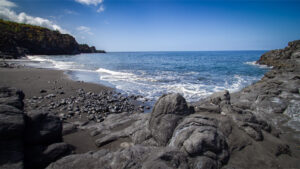
Charco Verde means green puddle – which sounds modest, but turns out to be one of the most beautiful bays of La Palma: just under 250 metres of dark sand, a bay framed by rugged steep slopes, and water that shimmers in a turquoise-green that hardly any camera can truly capture.
Playa de Tazacorte – Two Beaches at the Fishing Harbour
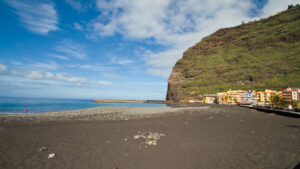
The road to Tazacorte goes downward. Always downward, through hairpin bends cut into the steep western slope of the island, past banana plantations whose leaves rattle in the wind – until the ocean is suddenly very close and the harbour opens up like a small world of its own. Puerto de Tazacorte, home to two beaches that enchant in their own quiet way.
Playa de Puerto Naos – Black Sand Beach on the West Coast
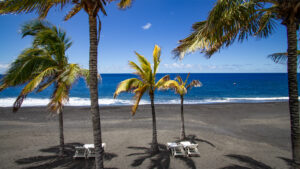
On the west coast of La Palma a different world opens up. The air carries salt and warmth in equal measure, and somewhere between palm rows and black volcanic sand the water shimmers in a turquoise that you do not forget quickly. Puerto Naos is not a loud place. It is a place where you arrive – and where you understand why La Palma is gladly called the green pearl of the Canaries.
Playa de Santa Cruz de La Palma – City Beach Close to Town
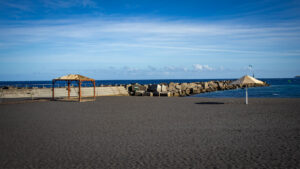
Those staying in the capital of La Palma do not need a hire car to reach the sea. The Playa Santa Cruz de La Palma lies right in the centre of Santa Cruz de La Palma, tucked between the harbour, the promenade and the old town – a beach that requires no effort, just a towel.
Beaches La Palma – The Complete Beach Guide
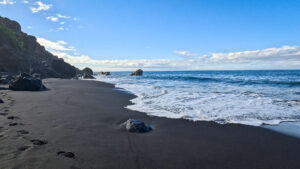
La Palma is not Lanzarote, not Fuerteventura, not Gran Canaria. The island has no endless white sand beaches, no beachfront promenades lined with hotels, no water parks. What it has is something different: black volcanic sand that stores warmth. Natural seawater pools in lava rock. Secluded bays you have to earn. And a coastline that shifts between pristine and wild within a few kilometres.