Paragliding on La Palma – Hawaii of the Skies
Among paraglider pilots, La Palma has been legendary for decades. They call it the Hawaii of the skies – for good reason: stable trade winds, thermal updrafts from volcanic terrain and landing strips right on the beach.
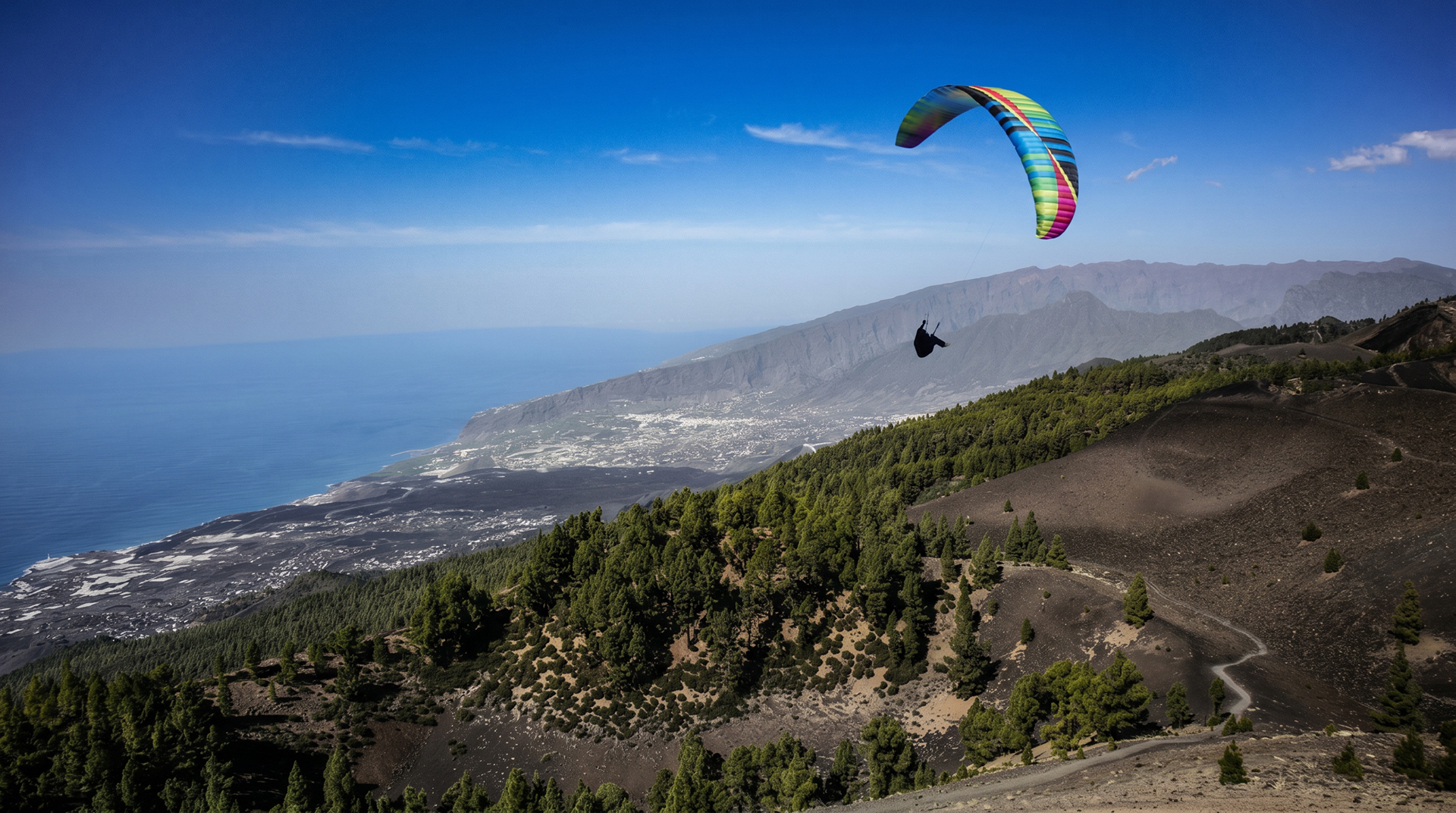
Anyone without their own wing can experience La Palma as a passenger: tandem flights with experienced pilots offer the same views, the same thermals and the same descent to the beach – no prior experience or license required.
The Best Flying Areas
Puerto Naos – The Classic
The classic flight on La Palma: launch at approx. 1,000 m altitude above Las Indias or at the Mirador de Tajuya, then glide down the western slope to the black sand beach of Puerto Naos. The flight takes 20–40 minutes depending on thermals.
Fuencaliente – Flights over Volcanic Cones
In the south of La Palma, above the San Antonio and Teneguía volcanic cones, Fuencaliente offers spectacular flying with views over the 2021 lava fields stretching into the sea.
Roque de los Muchachos – Experts Only
A flight from the summit of Roque de los Muchachos (2,426 m) down to the sea – one of the most extraordinary paragliding routes in Europe. Only for experienced pilots with extensive knowledge of local conditions.
The Best Launch Sites
| Puerto Naos / El Time | West coast classic. Launch at ~1,000 m, land on the beach. Ideal for evening flights in laminar sea breezes. |
|---|---|
| Puntallana | East coast. Thermal flying over lush laurel forests and the dramatic northeast coastline. |
| Fuencaliente | South coast. Spectacular flights over the dark volcanic cones of San Antonio and Teneguía. |
| Roque de los Muchachos | Summit (2,426 m). Experts only in flawless weather—a flight from peak to sea. |
Tandem Flights – La Palma from a Bird’s-Eye View
For everyone without their own wing: tandem flights last 15–45 minutes depending on the route and cost approx. 100–160 euros. Transfer to the launch site is included.
| Provider | Contact | Highlights |
|---|---|---|
| Palmaclub | WhatsApp: +34 609 00 23 44 | Oldest flight school, German/English |
| Fly La Palma | WhatsApp: +34 645 61 74 38 | Tandem flights, video service included |
| Ibrafly | WhatsApp: +34 626 53 10 38 | Focus on safety & panoramic views |
Visiting Pilots – What to Know
Guest pilots need a local briefing before flying on La Palma – strongly recommended via Palmaclub or Fly La Palma. The local wind patterns, especially in the transition zones between trade wind and thermal, differ significantly from continental flying sites.
| Tandem Price | Approx. €100–€160 (15–45 minutes) |
|---|---|
| Best Season | October to May (Most stable flight conditions) |
| Classic Landing Zone | Puerto Naos Beach |
| Guest Pilots | Safety briefing at Palmaclub mandatory |
| No-Fly Zone | Caldera de Taburiente National Park (Strictly prohibited) |
Evening Flights: The Best Time
The most popular time for tandem flights in Puerto Naos is early evening. The sea breeze then blows laminar, thermals settle and the light over the Aridane Valley turns golden. These flights are regularly booked out – book in advance.
Who Cannot Fly Tandem
Not everyone is suitable for tandem flights. Minimum weight approx. 40 kg, maximum weight depending on the operator 90 to 110 kg. Pregnancy and certain cardiovascular conditions are exclusion criteria – ask your operator in advance.
The Island from Above: What a Tandem Flight Reveals
Anyone who has once flown in a paraglider over the Aridane Valley sees La Palma differently afterwards. The banana plantations from above, the coastline, the Caldera rim in the distance – a perspective that no hiking trail can replicate.
Frequently Asked Questions (FAQ)
How long does a tandem flight on La Palma take?
Are there weight or age restrictions for tandem flights?
Flying Experience on La Palma – The Learning Curve
La Palma is not a beginner’s island for paragliders. The wind conditions – stable trade winds, abrupt thermals over volcanic terrain and rapid changes in the lee zones – require good basic skills and local knowledge.
The best time for solo flights is October to May: the trade wind is more stable and less built up than in summer. For beginners, tandem flights are always the right choice first.
La Palma from the Air – What You See
From above, La Palma reveals itself for what it is: a pyramid-shaped island rising steeply from the Atlantic, with a crater rim at over 2,000 metres and a coastline that plunges without transition straight into the deep sea.
This article is based on the on-site knowledge of the Gequo editorial team – publishers of the Reisezeit Hiking Guides and operators of Sunhikes.com. As of: May 2026